
Growing Up Loon
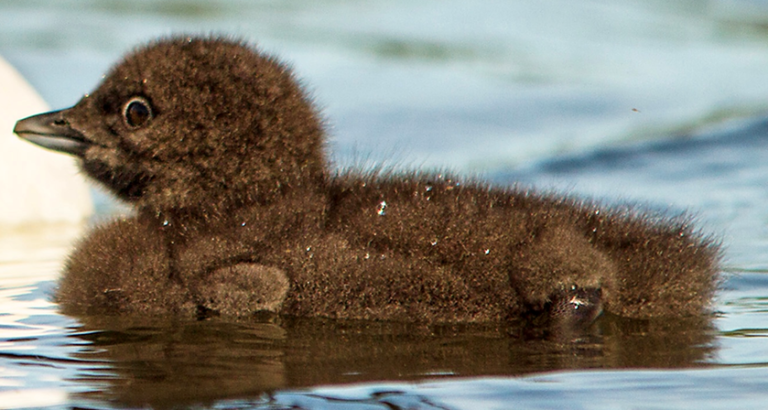
It looks like an idyllic childhood. Imagine you’re a baby loon, a little dark-gray ball of down, paddling along beside mom or dad, or between them. Maybe there’s a twin for companionship.
Get tired, climb on mom’s back and ride for a spell. Food is served continuously, fresh fish straight from the lake. Dip your head into the water, see the school of minnows where mom and dad are hunting. Watch dad catch a silvery victim in his long, sharp bill.
It looks like a great way to grow up, and maybe it is, but it’s also a serious time, survival at stake. It’s a race against time to take in enough food for energy to build up body mass and strength, develop the full complement of feathers, learn to dive, stay down for long intervals, catch fish to feed yourself (because sooner or later the Door Dash service ends) and ultimately undertake a couple thousand miles of migratory flight.
As a baby loon, you hatch from an egg with your dark downy feathers and white belly. Unlike your parents, you can walk upright on land. You can swim immediately, but those rides aboard mom or dad help keep your body temperature stable and isolate you from predators from below.
During your first week of life, your legs, feet, and head start growing and you spend more time paddling on your own. You can even swim down to shallow lake bottom areas and chase fish (though with not much success).
In your second week, you molt and grow a lighter brown coat. You can swim underwater for 50 feet or so; your parents are willing to leave you on your own while they both dive for fish to feed you, and themselves. (It’s estimated that two adult loons and two chicks eat about half a ton of fish in the time it takes for the babies to mature.)
Three weeks unto your life you begin to take on the shape of an adult and lose your ability to walk on land. By your fifth week you’re skilled enough in the water to catch small prey, but you still need your folks to feed you.
After eight to nine weeks, your juvenile plumage is fully developed. You can dive efficiently and catch about half the food you need. You exercise your wings as you gear up to fly. In a couple more weeks you can catch most of your own food, but you still beg meals from your parents. One adult or the other may take off on migration while the other stays with you.
By 12 weeks, you’re fully fledged and independent. You and fly, and you catch fish the same size as those your folks eat. Now the second parent takes off for the ocean; you stay on your natal lake for up to three weeks, maybe even into early winter, before heading south yourself.
Life down on the ocean has its own set of challenges and adaptation. Yes, maybe it’s a good life. That is not the same as easy.
(Photo of 2-week-old loon chick courtesy of Linda Grenzer)