
A better sky show
Fireworks look best over water, and if you doubt it, watch the people crowd around and the boats come out for lakefront Fourth of July displays. The sky explodes in colors caused by incandescence of elements and chemicals: Reds from strontium and lithium compounds, orange from calcium salts and carbonate, gold from iron and carbon, yellow from sodium, green from barium, and more. It can inspire awe.
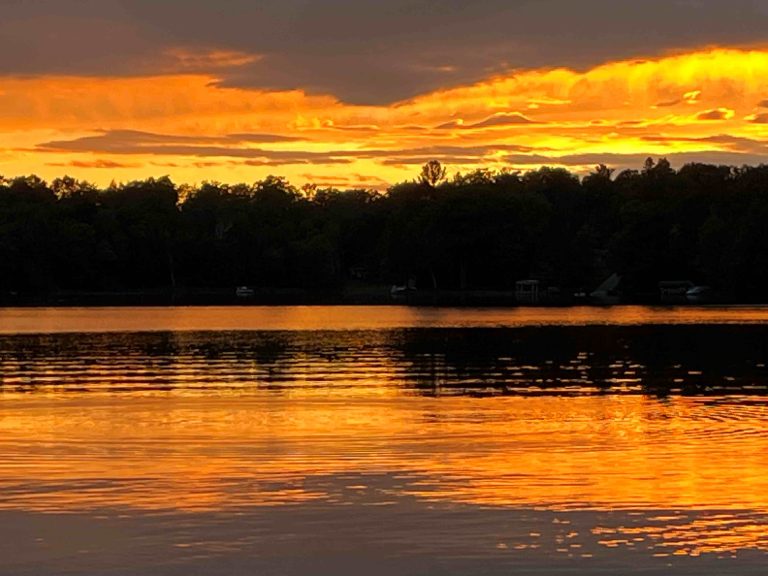
But equally impressive displays (though quieter) light the sky on most days of the year: sunsets and, for those willing to rise at the days’ first birdsongs, sunrises. And the colors we see low in the western and eastern skies have their own specific origins. We see the colors of sunset for the same reason we experience a clear sky as blue: a phenomenon called the Rayleigh scattering of light. Sunlight includes the seven colors of the visible spectrum. On reaching the earth, the white light scatters as it strikes gases and particles in the air.
Most of the red, yellow and green light waves stay mixed together and pass through the atmosphere to our eyes as white light. But the blue and violet light, which have shorter wavelengths, bounce off of the water vapor and other gas molecules and scatter in all directions. That is why to our eyes the sky is blue. Why don’t we see the scattered violet light? Partly because some of it is absorbed in the upper atmosphere, and partly because our eyes are less sensitive to violet than to blue.
At sunset, the picture changes: As the sun sinks lower, its light has to pass through more of the atmosphere to reach our eyes. So, more blue and violet light waves get scattered away, allowing the longer-wavelength reds and yellows to emerge (and mix to create orange). On clear evenings, we see a gradient of color from the horizon to the darkening sky above. The most striking sunsets, though, appear when clouds decorate the western sky. The types of clouds make a difference: The colors are the most vivid in the highest clouds, such as cirrus and altocumulus, often tinted in pink.
If you’ve observed that sunsets seem more vibrant in winter, that’s not your imagination. In warmer weather, water vapor clings to particles like pollen and dust, causing them to block light. Winter air holds less water vapor, and so more of the colorful light comes through. Sunsets also intensify when the air is filled with smoke, such as from wildfires. That’s because the smoke particles, being much larger than air molecules, enhance the scattering of the longer light waves, lighting up the horizon in brilliant red and orange.
We’ve all enjoyed fireworks since we were kids, but now perhaps we’re equally or more enchanted by sunsets, always available. From a fishing boat or from the bench at the end of our pier, we can watch in silent awe as a summer day goes out in a blaze of glory.