
How walleyes eat
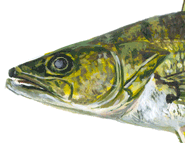
How walleyes eat
Different fish attack and eat their prey in different ways. If you understand their habits, you might improve your odds of catching your favorite species on your lake. You might think apex predator fish go about their feeding in much the same way, but that isn’t the case. For example, northern pike tend to wait in ambush and then slash at their prey from the side. Maybe you’ve had a big northern take a walleye you were reeling in; at boatside you see the walleye T-boned in the pike’s jaws.
Walleyes, on the other hand, are more stealthy. They tend to feed in low light when their superior night vision gives them an advantage over their prey. Two Illinois biologists, Lisa Einfalt and David Wahl, looked in more detail at how walleyes hunt and reported their observations in the Canadian Journal of Fisheries and Aquatic Sciences. They found that walleyes don’t chase individual prey fish but follow schools of fish of edible size. Rather than attack the middle of the school, they target individuals that stray outside the school’s edges.
In a similar manner, walleyes patrol the outer edge of weedbeds inhabited by numerous baitfish, such as small perch. Any prey that ventures outside the cover of the weeds will likely end up in a walleye’s jaws. All this, the researchers noted, aligns with something most anglers know: walleyes don’t spend a great deal of energy pursuing prey. Following a school and lurking outside the weeds are low-exertion approaches.
When taking prey, walleyes strike from below and behind. They inhale the baitfish at the tail and then manipulate it in their mouth so as to swallow it head first. This explains something an angler of my acquaintance once reported to me: When fishing with nightcrawlers he sometimes missed a strike and reeled in to find the crawler on his jig rolled into a ball. The walleye apparently was handling the worm as it would a slender minnow.
In the case of larger prey, walleyes may attack bait head-on. Not surprisingly, the researchers observed that large walleyes eat larger prey. They also found that walleyes prefer fish with a slender body profile. If facing a school of baitfish with a more rounded body shape (that is, more like a bluegill than a perch or sucker), they select smaller members of the school that more easily fit their mouth opening.
As for weather, while many anglers hate fishing in windy conditions, smart anglers know that a wind-whipped shoreline can be a hotbed of walleye activity. The wind blows plankton into the shallows, and waves stir up food from the bottom, and both conditions attract baitfish. Walleyes follow, and here again, their superior vision in darker, turbid water favors their feeding. Anglers who know these habits can gain an edge in deciding when to fish, in what places, with which baits, and with wat kind of presentation. And as any angler knows, a little edge comes in handy on at those frequent times when walleyes are finicky and hard to find.